
Lianhe Zaobao on Singapore's AI-Powered Micro-Drama Revolution: Spore Fall and the Asian Frontier
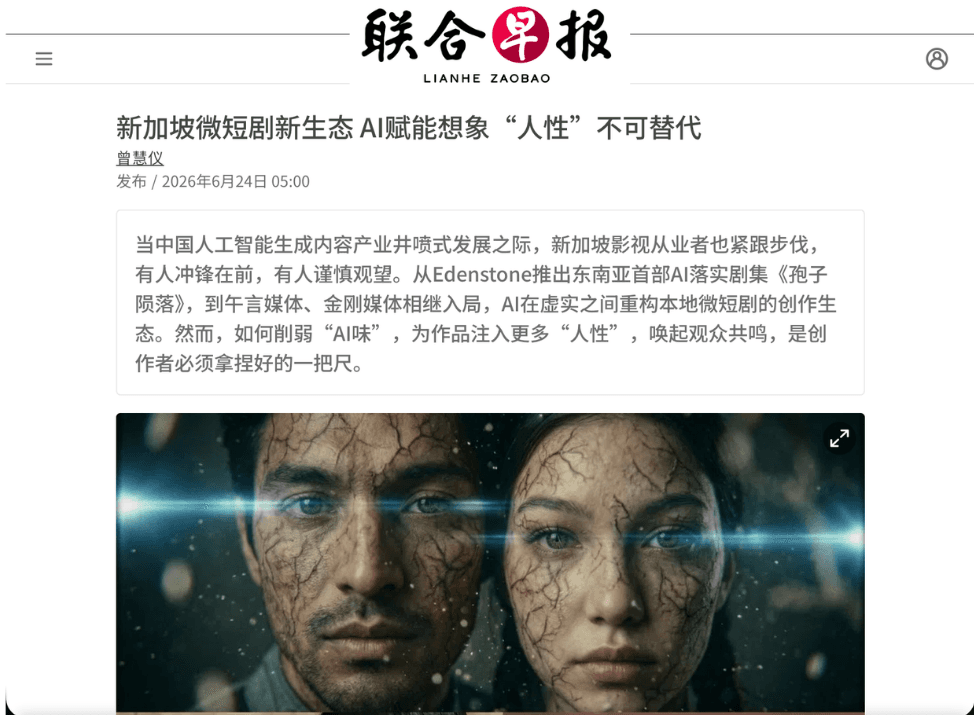
Singapore's new micro‑drama ecosystem: AI empowers imagination, but "humanity" cannot be replaced
Byline: Tseng Hui‑yi / Published 2026‑06‑24 05:00
As China's AI‑generated content industry surges forward, Singapore's film and television practitioners are keeping pace – some charging ahead, others treading cautiously. From Edenstone's release of Spore Fall, Southeast Asia's first fully AI‑produced drama series, to the subsequent entry of Nianyan Media and King Kong Media, AI is redrawing the boundaries of the local micro‑drama creative landscape, blurring the lines between the virtual and the real. Yet the challenge that creators must carefully navigate remains: how to temper the "AI flavour" and infuse their works with enough "humanity" to resonate with audiences.

Singapore’s micro‑drama market is closely following the broader environment, producing AIGC works as well as AI‑assisted live‑action content.
The meteoric rise of AI Generated Content (AIGC) has reshaped China's film and television production process at an unprecedented pace. Turning our lens to Singapore's micro‑drama market, local media practitioners have similarly been keeping step with the broader environment.
Spore Fall adapts a novel into a screen production

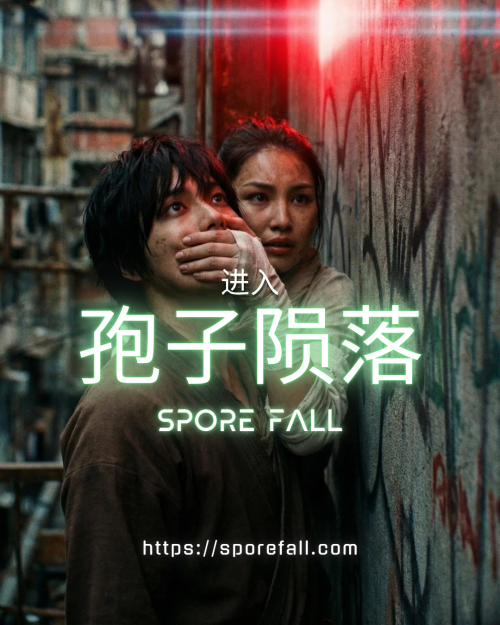
The English‑language short drama Spore Fall is set in the fictional city of “Lionara”. (Provided by Edenstone)
In March 2026, Singapore‑based Edenstone launched Spore Fall, an AI‑generated short drama. Set in the fictional city of "Lionara," this English‑language series follows a disillusioned soldier and an unconventional military doctor who are forced into an unlikely alliance amid a deadly spore outbreak and the iron grip of an authoritarian regime. Their common thread? An "awakened" infected individual endowed with special abilities – a force that could either catapult human evolution forward or seal humanity's fate forever.
Joel Boh, Managing Director of Edenstone and the series' creator, told Lianhe Zaobao that Spore Fall is Southeast Asia's first drama series written by humans and realised through AI. But his foray into AIGC was, in fact, a strategic pivot. " Spore Fall began as a novel project in early 2025," he said. "At the time, I had completed about 70% of the first draft and had originally planned to release the IP through traditional publishing. But the process was far too slow – after submitting the full manuscript, I would have faced an eight‑month wait, with no guarantee of success. The whole endeavour was fraught with uncertainty."
Meanwhile, he observed AI technology maturing and micro‑dramas gaining traction as a narrative medium. "So I changed course, assembled a team, and pivoted the project from print to screen." He explained that the project could move swiftly because the story framework was already in place: "AI accelerated the production workflow, enabling us to bring it to the screen much faster."

Joel Boh, with the help of AI, pivoted Spore Fall from physical publishing to screen production. (Photo provided by interviewee)
Overcoming the "AI flavour" is a challenge
Joel Boh revealed that Spore Fall was produced by a team of about 10 people. They adhered to the principle of "human creation, AI realisation" – the story itself was human-led, while AI was responsible for the "execution" aspects of the series, including generating scenes and visual effects. The AI tools they used included Higgsfield and Google Veo, while for visual generation, they combined Seedance and Nano Banana.
Although Spore Fall entrusted the most expensive aspects of traditional production to software, Boh firmly believes that humans must retain decision-making power over every creative and technical aspect to ensure video quality – "for example, prompt engineering, shot selection, and editing. Our principle is simple: technology should serve the story, not the other way around."

“The Edenstone approach is always human-led. We start with strong storytelling and worldbuilding — story arcs, character motivations, emotional truth come first. AI then scales and executes that vision, not the other way around.”
He clarified that “Audiences are receptive — but only to content that feels purposeful and original. The question isn't about the technology. It's about connecting to the story.”
For Boh, the future of storytelling is immersive, interactive, and boundless. Audiences today crave more than passive entertainment – they want to step inside the narrative. Boh elaborates that Edenstone has built Spore Fall as a 1st proof-of-concept flagship narrative universe.
“Our vision is to become the next Disney — scaled by AI, powered by Web3 — where audiences don't just consume, but participate, co-own, and hold a stake in the transmedia ecosystem.”

Translated from mandarin.
Original article: https://www.zaobao.com.sg/entertainment/story20260624-9241679